
DDoS Testing
Why test DDoS protection — and not just purchase it?
Organizations invest in DDoS mitigation: scrubbing services, CDN configurations, rate limiting, fail-over architecture. But how do you know that all these layers are correctly configured and work together under real attack pressure?
What remains untested is uncertain:
- Whether your CDN and scrubbing provider can handle the attack volumes that truly threaten you
- Whether your firewall rules fail or hold up during a SYN flood
- Whether your fail-over procedures are executed timely and correctly
- Whether your team detects attacks in time and follows the correct escalation steps
- Whether your application layer is resistant to slowloris and HTTP flood attacks
- Whether your critical API endpoints are specifically vulnerable to targeted application layer attacks
Mitigation software that has never been put under pressure offers paper security. A controlled DDoS test provides demonstrable assurance.

What DEFION DDoS Testing concretely delivers
Our specialists simulate realistic attack scenarios tailored to your threat profile and architecture:
✔ Volumetric attacks — UDP floods, ICMP storms, DNS amplification: test whether your bandwidth and scrubbing capacity hold up
✔ Protocol-oriented attacks — TCP SYN floods, fragmented packet attacks, ACK floods: validation of stateful inspection and firewall behavior
✔ Application layer attacks (Layer 7) — HTTP/HTTPS floods, slowloris, cache-busting: test of WAF, rate limiting and backend capacity
✔ Multi-vector attacks — Combined attack types simultaneously, as a real targeted DDoS attack works
✔ Mitigation validation — Confirmation that your CDN, scrubbing and anti-DDoS services respond correctly
✔ Detection and response test — Measurement of time-to-detect and time-to-respond by your team and procedures
✔ Impact and degradation analysis — How quickly response times deteriorate, which threshold is critical?
✔ Concrete recommendations — Targeted improvement measures per identified weakness
The three levels of DDoS resilience that we test
Technical layer — your infrastructure
Bandwidth, scrubbing capacity, firewall behavior, CDN configuration, DNS resilience. We test whether your technical defense does what the provider promises.
Application layer — your services
Web applications and APIs are often the weakest point in DDoS defense. Layer 7 attacks bypass volumetric mitigation and target specific endpoints. We test which endpoints are vulnerable and how your WAF and rate limiting perform.
Operational layer — your team and processes
A DDoS attack is also an operational incident. Does your NOC or SOC detect the attack in time? Are the correct procedures followed? Who communicates internally and externally? We evaluate your operational response and identify areas for improvement.
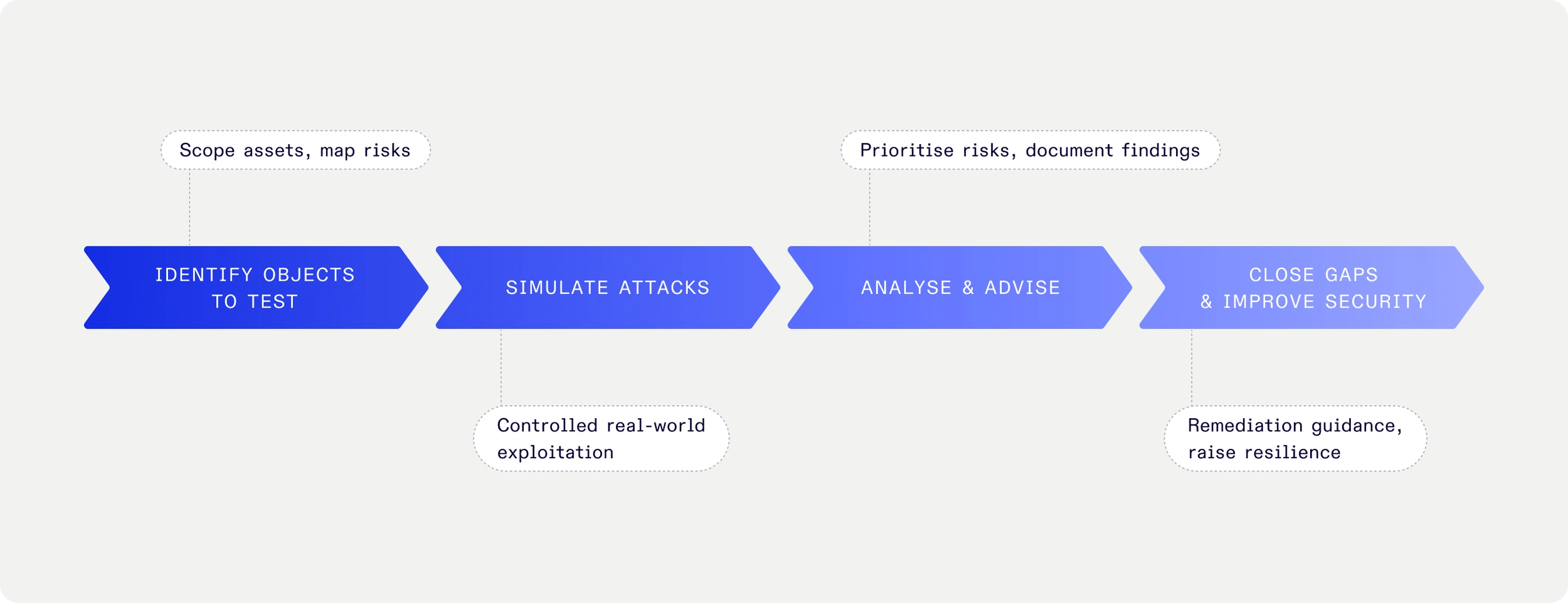
For organizations that prefer to outpace attackers
For which organizations is DDoS Testing essential?
DDoS tests are indispensable for organizations:
With online services where availability equals revenue — e-commerce, ticketing, online platforms
In the financial sector — banks, insurers, payment processors: availability is legally required
In critical infrastructure — energy, water, transport, telecom: NIS2 sets explicit requirements for resilience testing
That depend on public trust — government, healthcare, education: downtime has societal impact
With recent investments in DDoS mitigation that they want to validate before an attack does
After a previous DDoS attack that raises the question: are we now truly better protected?
For planned events or launches that become targets for targeted attacks
Do you want to get ahead of attackers quickly? Contact us immediately.
"New requirements from NIS2 for OT systems increase the focus on security. With DEFION, we know that we have the right expertise in-house. The collaboration was pleasant; the specialists were truly alongside us rather than opposite us." NAD Pump Station Management, manager of hydraulic engineering infrastructure
"Thanks to DEFION, we benefit from up-to-date knowledge about contemporary security threats and means to avert risks. We have peace of mind knowing we are fully supported 24/7 by their team.”
Jeroen van Stokkum Manager ICT
![[object Object]](https://assets.defion.security/api/assets/images/l7GY2Z9ip58BiQ5Bckyaz6f4Kz3KdM-w2000.webp?t=3840)
“The sector and the partners we work with maintain increasingly high security standards for IoT-products and services. Protecting the privacy of individuals in the images and the sensitivity of the information the drones collect, such as on objects in critical infrastructure, requires our security to be airtight. With Defion, we are working with a professional partner who can support us at the right level. The collaboration also fits perfectly within our strategy to deliver reliable and secure drone technology to European customers.”
Benjamin van der Hilst Co-Founder & CEO

“New requirements from NIS2 for OT systems are increasing the focus on security. With Defion, we know we have the right expertise in-house to keep our systems secure. The collaboration was easy and pleasant; the specialists truly sat next to us rather than across from us. Thanks to their openness and expertise, we are working together toward the same goal: optimal security. This gives us the confidence to face the future.”
Alexander OdijkTeam Manager

“If you look at where we were ten years ago, we’ve made enormous progress. The sense of control is greater. With Security Assurance and MDR we have set up processes and control mechanisms that allow us to limit the impact of a potential attack. The collaboration also serves as a constant reminder to maintain focus on security and set the right priorities in that area. It keeps us alert and sharp. Moreover, Defion’s specialists are highly technical and passionate about their field. That clearly shows in their services.”
Gerco VermeerDevelopment Manager