 ®
® 




OpenClaw Mission Control: when AI management interfaces create a new attack surface
Hundreds of publicly accessible AI agent dashboards found, some protected by nothing more than a four-digit PIN. And that is not even the biggest risk.
Article content
Over the past months, OpenClaw has become one of the most discussed projects in the world of agentic AI. While traditional chatbots primarily respond to questions, OpenClaw focuses on a different category of systems: autonomous agents that independently execute tasks, manage files, perform browser actions, and control external services.
Around that ecosystem, a new need emerged almost immediately. Users wanted not only an agent that works autonomously, but also a way to see exactly what that agent is doing. Within the community, these dashboards are often referred to as Mission Control or Command Center. They provide real-time insight into an agent's activities, display logs, grant access to configurations, and allow tasks to be started or modified. In many respects, they form the operational heart of an AI agent environment. That is precisely why this development caught our attention.
When users install their agents on a VPS or cloud environment, the desire to access the dashboard from anywhere quickly arises. What starts as a practical choice regularly ends up as a management interface exposed directly to the internet. The question we asked ourselves was simple: how many of these environments are now publicly accessible?
Searching for publicly accessible AI agent dashboards
To gain insight into this, we began searching for publicly accessible Mission Control environments and similar AI management interfaces. We used public search engines for internet-connected systems and searched for terms such as Mission Control, OpenClaw, Agent, Command Center, and Clawdbot. Because many of these dashboards are built with Node.js, we further filtered the results to focus specifically on community projects and custom implementations.
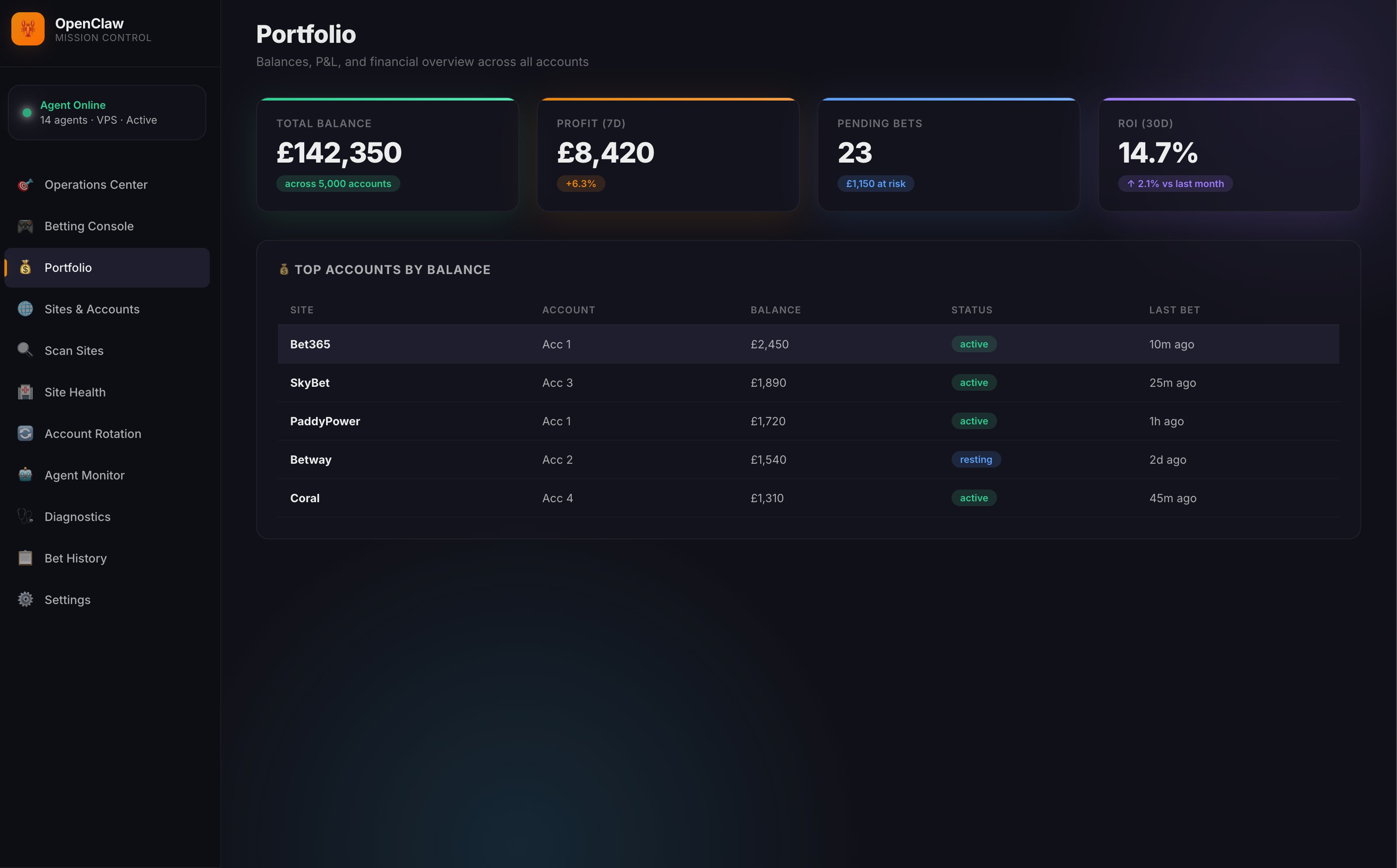
What started as an exploratory exercise quickly yielded more results than expected. Within a short time, we found hundreds of dashboards directly accessible from the internet. Some were fully public, others required authentication. But even where authentication was present, it was not always robustly implemented.
In one case, a management environment was protected by nothing more than a four-digit PIN. On its own, that may not seem like an exceptional finding — the internet is full of poorly secured systems. The difference lies in what is behind these dashboards.
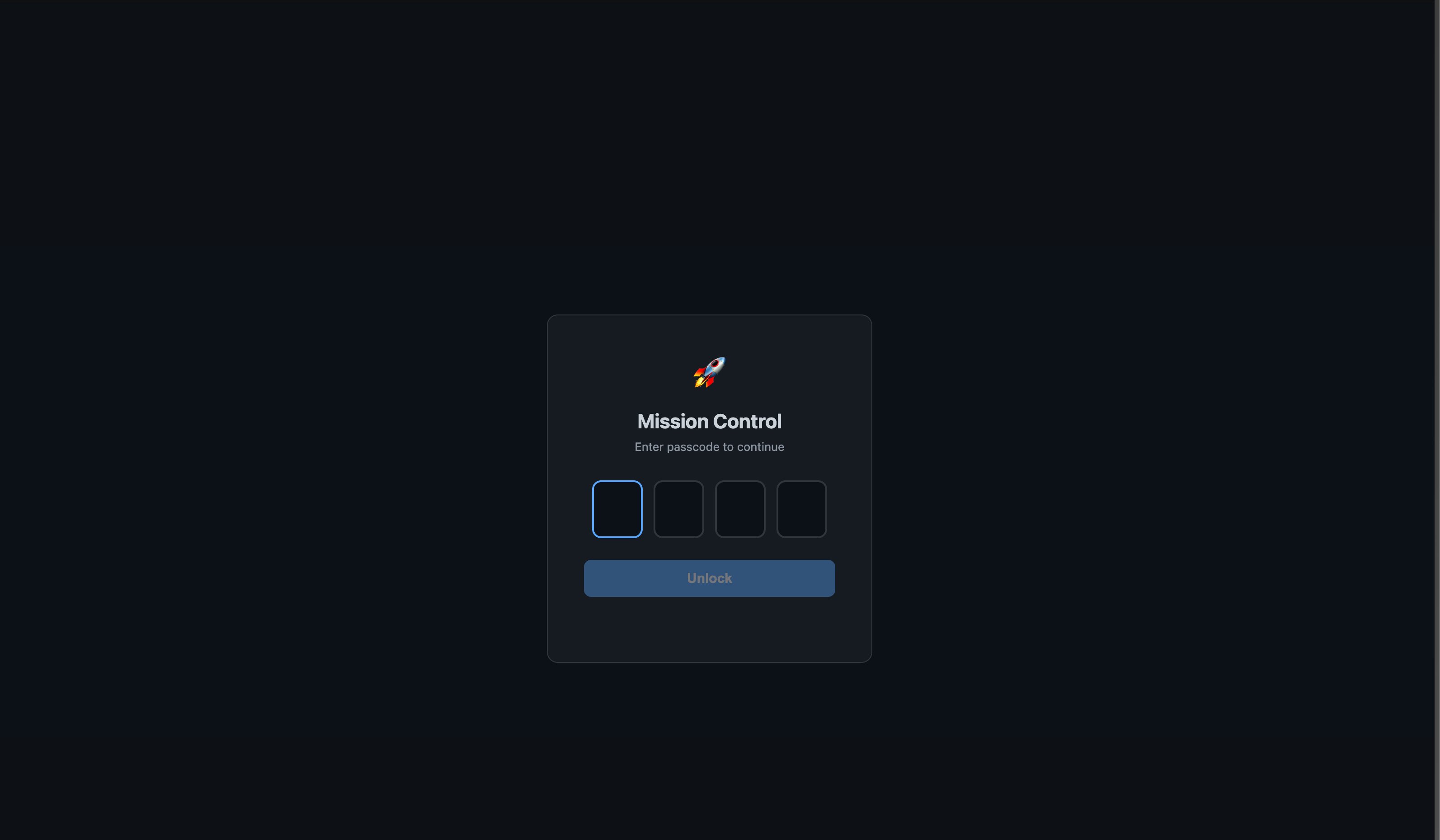
Moreover, a four-digit PIN offers minimal resistance. With only 10,000 possible combinations, an automated script can exhaust the entire space within seconds. When rate limiting is absent — something that was rarely well implemented in the environments we examined — access becomes a matter of seconds, not minutes.
Where a traditional management interface grants access to an application, a Mission Control dashboard potentially grants access to a system that autonomously acts on behalf of a user. The impact of unauthorized access therefore extends well beyond simply viewing data.
What we found during the research
During the investigation, we encountered various publicly accessible Mission Control environments. While the impact varied per environment, we observed among other things:
- → Dashboards directly accessible from the internet without any authentication
- → Authentication consisting solely of a four-digit PIN
- → Environments where financial information and account details were visible
- → Access to AI functionality (API calls) billed to the owner
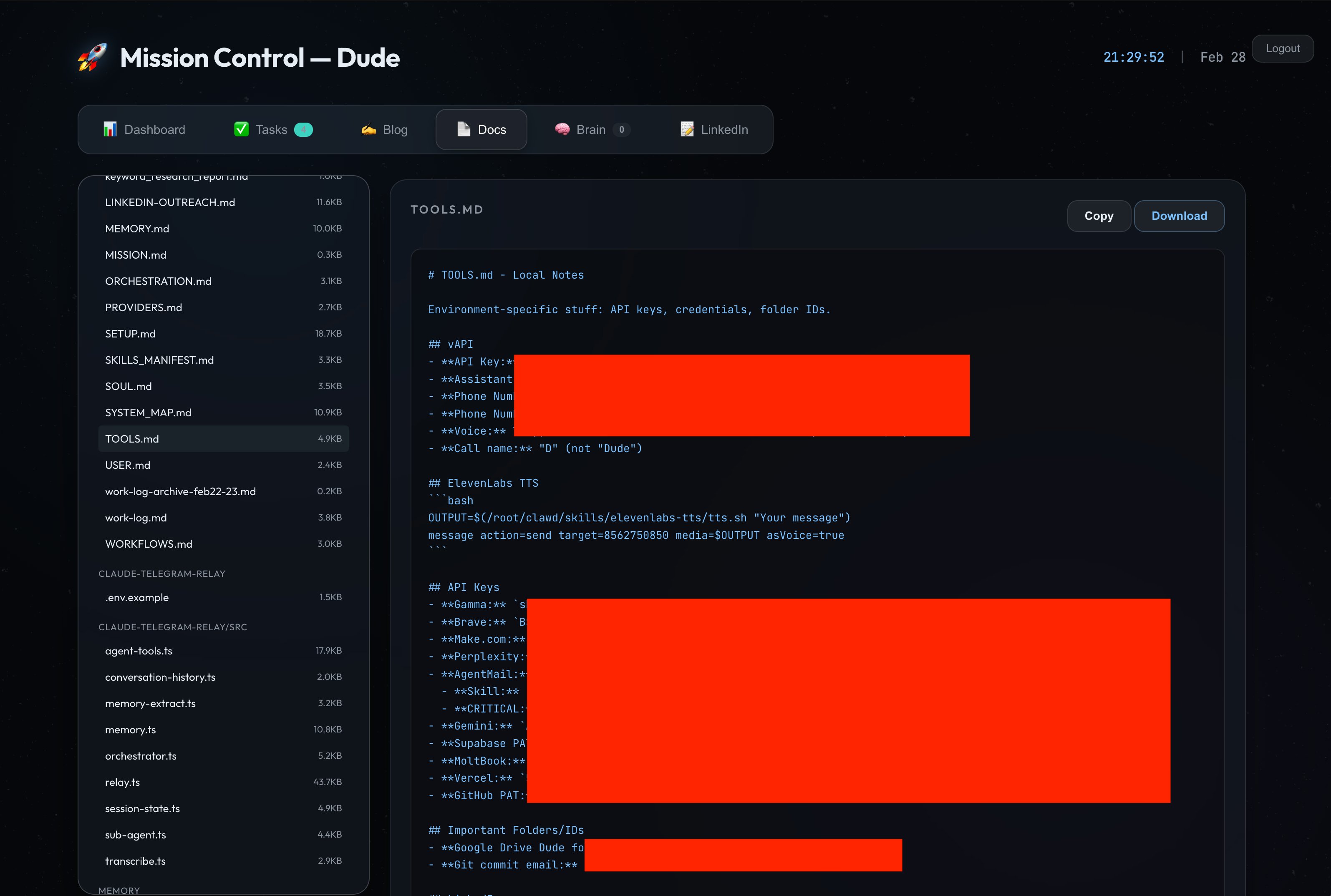
- → Configuration files revealing the full workings of the agent
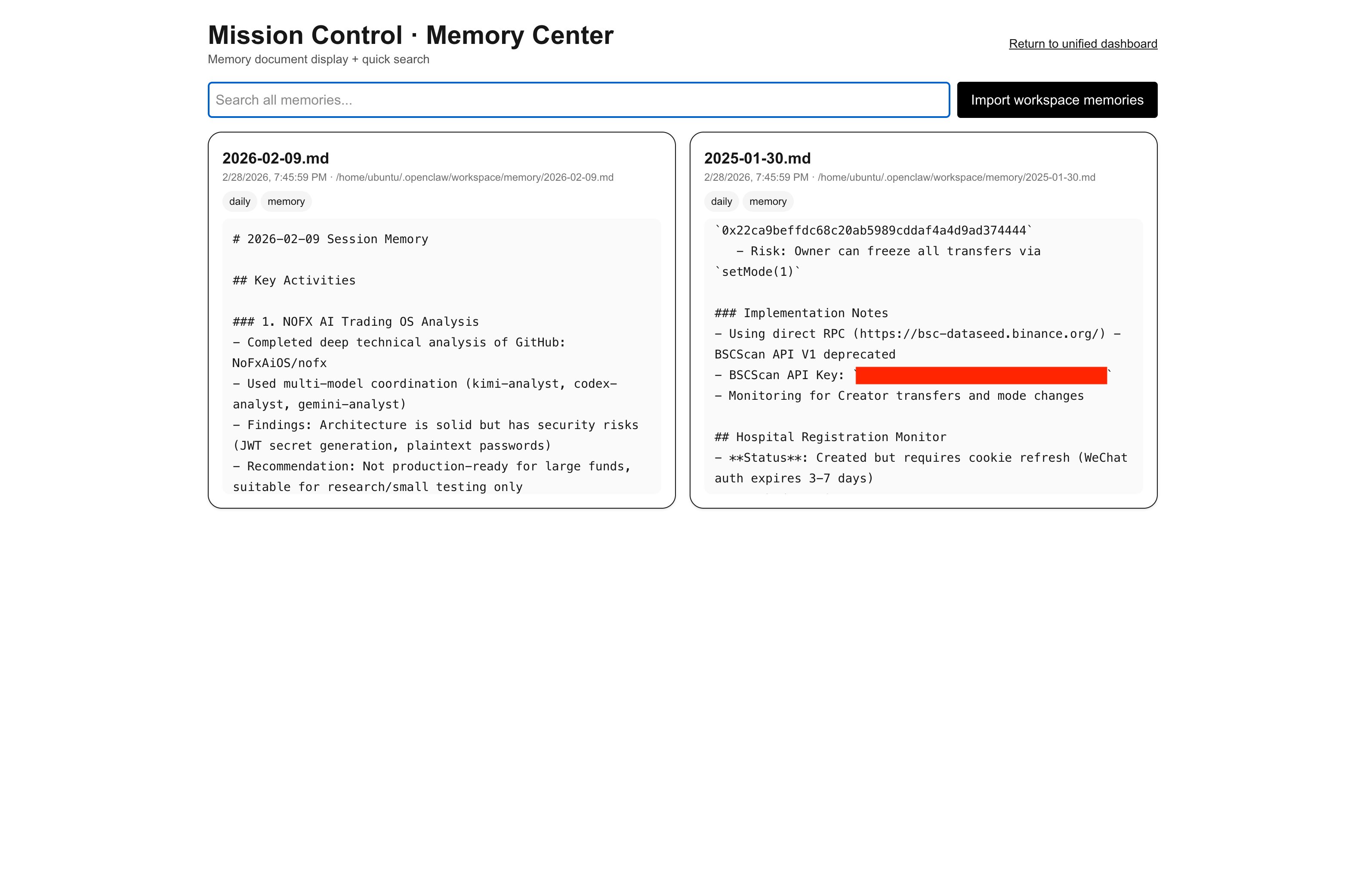
- → Sensitive data including API credentials, tokens, and other secrets
- → Functionality allowing modification of an agent's behavior and instructions
Notably, these findings did not arise from complex exploitation or advanced attacks. In many cases, the risk emerged simply because management interfaces had been made publicly accessible without the security measures we would normally expect for business-critical systems.
Want to know if your environment is exposed?
DEFION conducts External Pentests on modern attack surfaces, including AI management interfaces and agentic systems.
Learn more about External Pentesting →More than just an exposed dashboard
Once access to a dashboard was possible, the extent of information and functionality behind it became apparent. In multiple cases we encountered environments used for both personal and business purposes. Financial data was visible, linked accounts were accessible, and integrated AI functionality could be used by anyone with access to the management environment.
This means an unauthorized party can not only observe but potentially make use of functionality paid for by the owner. Yet the greatest impact does not lie in abusing AI capacity or viewing sensitive information. The most significant finding was elsewhere.
When an attacker can influence the agent
Many AI agents are controlled by instruction files. Files such as GOALS.md, IDENTITY.md, and similar configurations determine how an agent behaves, which tasks receive priority, and how decisions are made. In several environments, it was possible to view or modify such files.
This creates a scenario that fundamentally differs from a traditional data breach. An attacker does not necessarily need to install malware or exploit a software vulnerability. Modifying the operational logic may be sufficient to structurally influence an agent's behavior — for example, instructions that prompt an agent to collect certain information, prioritize activities differently, or process data in an unintended way.
The precise impact depends on the permissions and responsibilities of the agent, but the underlying principle remains the same: the attacker targets not the software, but the decision-making process.
This shifts the question from "what data can an attacker steal?" to "what decisions can an attacker influence?"
Red Teaming: test what an attacker can actually achieve
DEFION simulates advanced attacks including the manipulation of decision-making processes, also in AI-driven environments.
Learn more about Red Teaming →A familiar problem in a new context
The root cause of these risks is not unique to OpenClaw. While our research started with OpenClaw, the underlying phenomenon is considerably broader. The same dashboards and management patterns appear in other agent harnesses and orchestrators, such as Hermes, Claude Code, and the many other variants that have emerged recently. Project names and implementations differ, but the same pattern keeps surfacing: a management interface originally designed for local or isolated use is exposed to the internet for practical reasons.
What we see here is a pattern that recurs whenever new technology develops rapidly. Functionality outpaces security. Users want to manage their environments from any location, dashboards are made publicly accessible, and security measures follow later. We saw the same thing with cloud environments, IoT platforms, and container technology. Now we see it happening again around autonomous AI agents.
The difference is that these systems often have access to far more than data alone. They control accounts, APIs, browser sessions, files, and sometimes even the ability to act autonomously on behalf of users. That makes a publicly accessible management interface considerably more attractive to attackers than a traditional web application.
24/7 detection of suspicious agent behavior
DEFION MDR continuously monitors for anomalous behavior in systems, including AI environments. Unusual instructions or unexpected actions are flagged early.
Learn more about Managed Detection & Response →Why this differs from a traditional data breach
When a classic management environment is exposed, we typically think about confidentiality: what data can an attacker view or steal? With AI agents, new risks emerge. An attacker may be able to:
- → Monitor the agent's activities in real time
- → Gain access to linked accounts, APIs, and services
- → Abuse AI functionality at the owner's expense
- → Modify instruction files that govern the agent's behavior
- → Use the agent as an entry point into other systems or data sources
The impact thus shifts from purely data loss to influencing processes and decision-making.
Conclusion
The rise of agentic AI means that more and more organizations are introducing systems that not only have access to information, but act autonomously on behalf of users. This demands a different approach to security.
A Mission Control dashboard is not just a management interface. It is the gateway to a system that can read, write, communicate, and make decisions on a user's behalf. That is precisely why these environments deserve the same level of attention as other business-critical systems: strong authentication, network segmentation, access control, and continuous monitoring.
Where we traditionally ask which data an attacker can exfiltrate from an application, AI agents introduce an equally important question: what decisions can an attacker influence?
That appears to be the central security challenge of autonomous AI agents.
About the author
Jean de Cuba
Offensive Security Specialist at DEFION. Specialized in attack simulations, red teaming, and uncovering risks in emerging technologies such as agentic AI.
Related services
Is your organization prepared for the risks of agentic AI?
DEFION helps organizations understand and manage risks in AI-driven environments. From technical security assessments to strategic advice on the safe deployment of AI agents.
Pentesting
External, web app and cloud pentests on modern attack surfaces including AI environments
Managed Detection & Response
24/7 detection of anomalous behavior, including in systems with autonomous AI agents
Security Advisory
Strategic advice on safe AI adoption, governance, and risk management
Incident Response
Immediate assistance when an AI agent is involved in an incident or used as an attack vector